Gameday Men's Health
Gameday Men's Health


We researched Gameday Men's Health's positioning, audience, and competitive landscape. Then we built a complete client acquisition funnel: ad scripts, VSL, email sequences, and funnel architecture. Ready to deploy.
Before building anything, we researched Gameday Men's Health's business: positioning, audience, competitors, and current funnel. Here's what stood out.
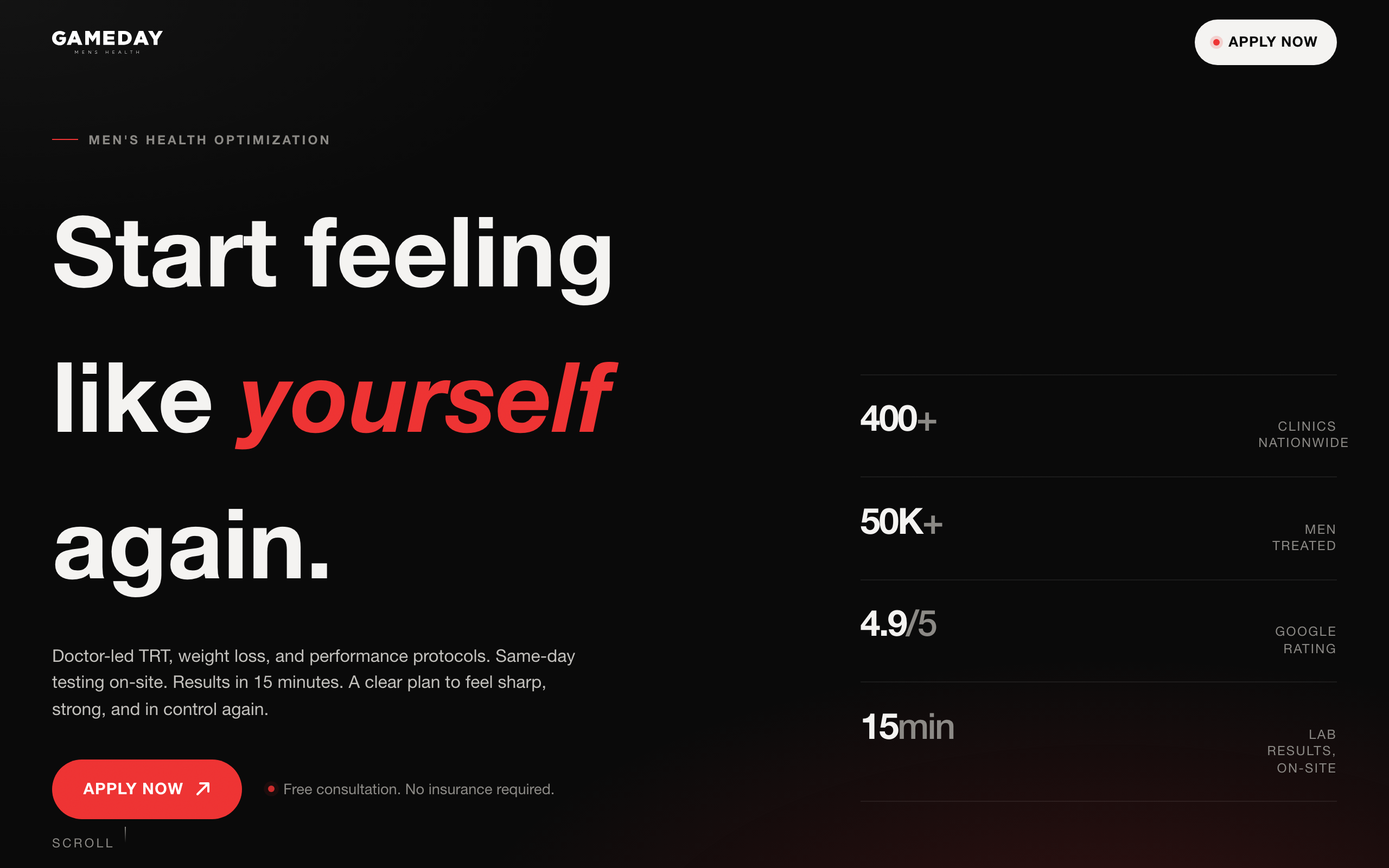
Your edge: 400+ clinics across US & Canada - largest men's health clinic network. That thread runs through every piece of content below.
We analyzed 4 direct competitors and studied what they're running. The scripts we built position Gameday Men's Health differently.
The #1 thing on their mind before they book: persistent fatigue and low energy that impacts work performance and family life. Every piece of content below addresses it.
Everything below was written for Gameday Men's Health. Click any section to read the full piece.
Hook - first 5 seconds
"Most guys who walk into our clinic don't think they have a testosterone problem. They think they're burned out."
B-roll: man at desk rubbing his eyes, mid-afternoon. cut to same man dragging through a workout.
Body
"They're eating right. They're in the gym three, four days a week. And they still feel like they're running on empty."
"We hear it constantly. 'My doctor said my levels are fine.' But 'fine' is a 300-point range. A 35-year-old and a 70-year-old can both land in the 'normal' zone."
B-roll: quick shot of on-site lab, then close-up of lab results on screen.
"At Gameday we test your levels on-site and have results in 15 minutes, instead of the usual two-week wait and a phone call that says 'everything looks normal.' Clear numbers, explained by a clinician who only treats men."
CTA
"Your first consultation is free. Walk in, get tested, and walk out with a game plan. Find your nearest Gameday clinic and book today."
---
Hook - first 5 seconds
"One thing most guys tell us at their first visit: 'My wife noticed before I did.'"
Body
"She probably noticed before you did. Something changed, and she's been watching it happen for months without saying anything."
"And she probably didn't say anything for months, because she didn't want to make you feel worse."
B-roll: couple on couch, subtle disconnect. then: same couple laughing together, active.
"Testosterone affects mood, energy, patience, and how you show up at home."
"Treatment plans at Gameday start at $199 a month. Personalized to your labs, supervised by our medical team, and you can begin the same day you walk in."
CTA
"Book your free consultation at your nearest Gameday clinic. Same-day appointments, on-site labs, results in 15 minutes. No referral needed."
---
Hook - first 5 seconds
"Before their first appointment, most guys ask us the same thing: 'Is this actually safe?'"
Body
"Fair question. And we've answered it over 50,000 times."
"Gameday has 3,000 clinicians across 400 clinics in the US and Canada, all focused on one thing: men's health. That's all we do."
B-roll: clinic interior, sports on screens, private exam room. quick shot of clinician reviewing labs with patient.
"Every protocol is built around your actual bloodwork, including testosterone and PSA. It isn't a cookie-cutter prescription."
"If treatment isn't right for you, we'll tell you that. Our founder started Gameday because he went through low T himself and hated the experience everywhere else. Cold offices, rushed appointments, no real answers."
B-roll: gameday clinic entrance, patient walking in casually. sports-lounge-style waiting area.
CTA
"Your consultation is free. On-site testing, results in 15 minutes, and a real conversation with a clinician who gets it. Book at your nearest Gameday clinic."
---
Hook - first 5 seconds
"Henry walked into one of our clinics and told us what most guys tell us: 'I've tried everything.'"
Body
"Eating clean, working out, and still gaining weight around the middle while dragging through every afternoon."
"We ran his labs on-site. Had his results in 15 minutes. Built a protocol around what his body actually needed."
Text on screen: "left that day with a game plan and in less than 3 months have lost 38lbs and feeling great. it truly was life changing." - henry w., gameday patient
"That's a real review. One of over 50,000 across our 400+ clinics, averaging 4.9 stars."
CTA
"Your first consultation is free. Same-day appointments, same-day testing, and a game plan built for you. Book at gamedaymenshealth.com."
---
Hook - first 5 seconds
Off-camera interviewer: "What's the first thing guys say when they walk in here?"
Clinician, smiling: "Usually? 'This is not what I expected.'"
Body
B-roll: clinic interior. tvs with sports. clean, modern space. no sterile hospital vibe.
Clinician: "Most guys put off going to a doctor about this stuff for months. Sometimes years. They don't want a cold waiting room or an awkward conversation followed by a two-week wait for results."
"Here, you walk in, we draw your blood on-site, and you have your testosterone and PSA numbers in about 15 minutes. Same visit."
"We only see men here, so there's no explaining why you showed up. Everyone's here for the same reason."
B-roll: patient and clinician reviewing results on a screen together, relaxed body language.
Clinician: "If your numbers show you'd benefit from treatment, we can start the same day. If they don't, we'll tell you that too. No pressure, just clear answers."
CTA
"Book your free consultation at your nearest Gameday clinic. We have over 400 locations. Find the one closest to you at gamedaymenshealth.com."
Offer: Free Consultation → Personalized Treatment Plans (TRT, ED, Weight Loss, Peptides)
Estimated length: ~7 minutes
Length: ~90 seconds
Length: ~90 seconds
Length: ~80 seconds
Length: ~75 seconds
Length: ~90 seconds
Length: ~80 seconds
## Page layout recommendation
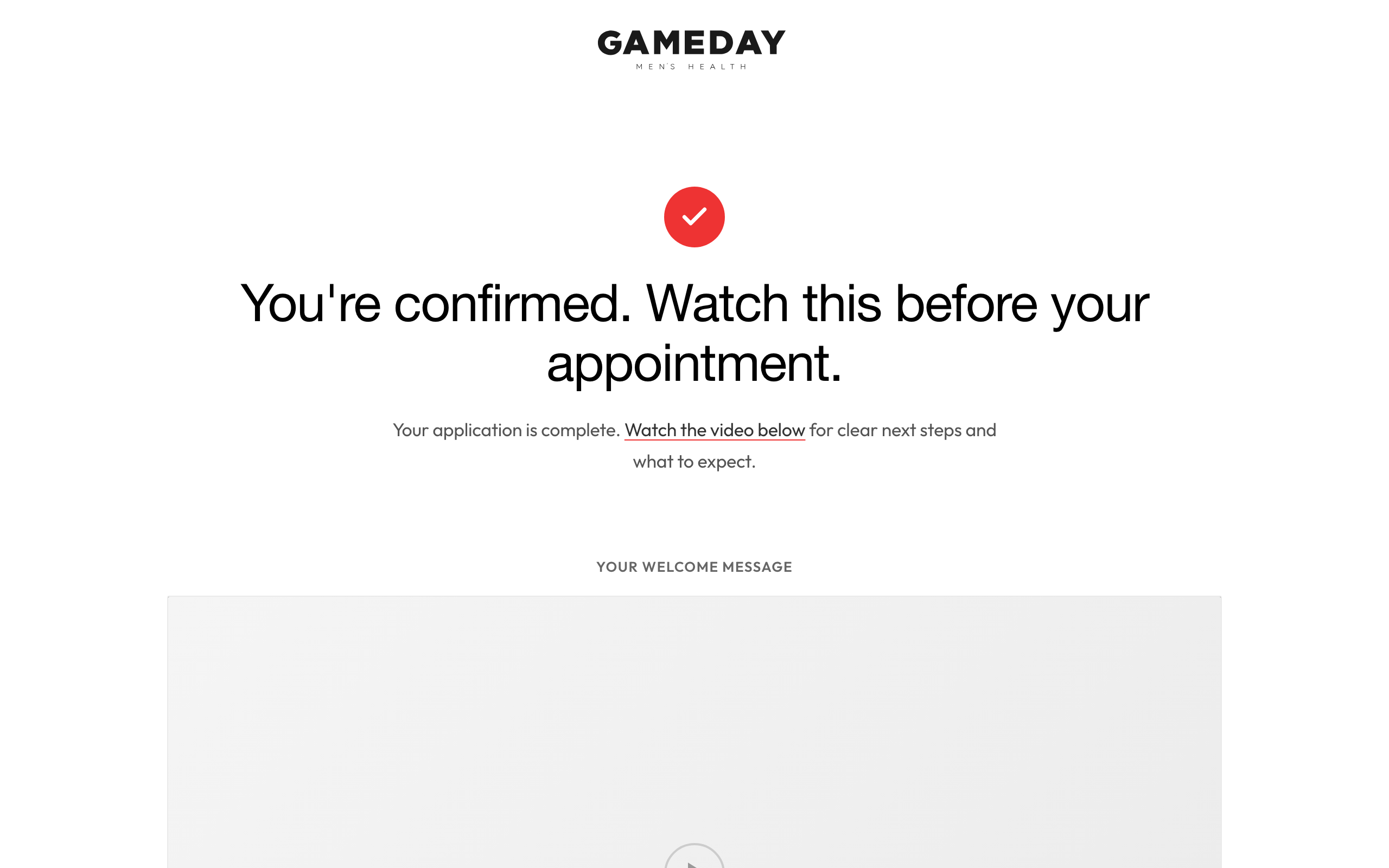
Order on confirmation page (top to bottom): 1. Main confirmation video (appointment details, what to expect, introduce breakout section)
2. "How much does it actually cost?" (deal-killer, address first)
3. "Is testosterone therapy safe?" (high anxiety topic)
4. "What if it doesn't work for me?" (risk mitigation)
5. "How long until I actually feel different?" (timeline sets expectations)
6. "Why should I trust Gameday over my regular doctor?" (credibility)
7. "I don't want to be on injections forever" (lingering concern, clean close)
Follow-up integration: These topics should be echoed in the pre-appointment email sequence. If a prospect clicks on a breakout video but doesn't attend their appointment, the follow-up email can reference the same topic ("We know you had questions about safety, here's what our Chief Medical Officer has to say...") to re-engage.
Subject: Your gameday consultation is set, here's what to expect
Preview: On-site labs, real numbers, walking out with a real plan.
Send: Immediately after booking (automated trigger)
Hey {{first_name}},
You're booked, and your spot is held.
Quick read on what actually happens once you walk in.
You'll meet your clinician one-on-one, get an on-site blood draw for testosterone and PSA, and have your results in your hands in about 15 minutes. From there, your clinician sits down with you, walks through your numbers in plain language, and lays out what your specific biology and goals point toward. The whole visit runs about 45 minutes, and you leave with a real plan rather than a "we'll call you in a week."
Over the next few days, we'll send you a short series of emails covering the questions most men want answered before they walk in:
- What TRT actually does to your body, and what it doesn't
- Why "normal" lab ranges aren't the full picture
- What happens if your numbers come back fine
- What the experience inside the clinic actually feels like
- The medical questions worth asking your clinician
You don't have to read any of it. Your appointment is yours either way. But if you want to walk in already knowing what you're looking at, the next few emails will get you there.
In the meantime, if you want to know who you're working with, our team is led by Dr. Haleem Mohammed, our Chief Medical Officer and a board-certified internal medicine physician who specializes in hormone optimization and longevity. The broader Gameday network includes 3,000+ clinicians across 400+ clinics, with a 4.9-star average from 50,000+ patient reviews on Google.
Meet the medical team here: https://gamedaymenshealth.com/about/
The Gameday Team
---
Subject: The question most men ask but don't ask out loud
Preview: Sports on the screens, private rooms, staff who get why you're here.
Send: Day 1, 9:00 AM local time
Hey {{first_name}},
Here's the question I'd bet you've been turning over since you booked, even if you'd never say it out loud.
What's it actually going to be like walking in? Will the staff know exactly why you're there the second you check in? Is there a waiting room full of guys avoiding eye contact? What if someone you know walks past?
Most men sitting in front of a Gameday consultation form ask some version of this, so let's just put it on the table.
The clinic is built specifically to take this concern off your shoulders. The space looks closer to a sports lounge than a doctor's office, with games on the screens, modern design, and private consultation rooms with the door closed. The staff is trained to talk to you like a teammate rather than a patient with an embarrassing problem, and your appointment runs one-on-one with your clinician from the first conversation through your lab review.
That structure also takes care of the smaller things you might be thinking about:
- No nurse triage in an open hallway
- No one asking your reason for visit at a front desk where another patient can hear you
- Communication runs through your phone and email, not a physical mailer with a clinic logo on the envelope
- Telehealth follow-ups are an option from day one if you want to keep all future contact off-site
50,000+ men have walked through this exact process, and the most common thing they say afterward is some version of "I should have done this sooner." You're not the youngest guy who's ever booked, you're not the most unusual case anyone's seen, and the discomfort you might be feeling about the category itself is the most predictable part of the whole process. You're a typical guy doing a smart thing.
The Gameday Team
---
Subject: What henry actually did to drop 38 pounds in 90 days
Preview: A short story, a hard conversation, and what to look for.
Send: Day 1, 4:00 PM local time
Hey {{first_name}},
Henry came into one of our clinics about a year ago. Late forties, working professional, married, and had been "trying to get back into shape" for the better part of two years without much to show for it.
In his words after his first appointment: "Left that day with a game plan and in less than 3 months have lost 38lbs and feeling great. It truly was life changing."
Don't read that as a flex. Read it as a question worth asking, which is what was actually inside the game plan that produced that result. Three things, in this order:
1. We tested before we prescribed. His on-site labs showed where his testosterone, body composition, and metabolic markers actually sat. The protocol was built off real numbers, not a symptom checklist or a guess based on how he looked when he walked in.
2. We treated the underlying biology, not just the surface symptom. His weight wasn't a willpower problem, it was a hormonal and metabolic one, and the protocol we built addressed the root cause and let the body composition follow.
3. We monitored and adjusted. Body composition scans and lab follow-ups at the right intervals meant the protocol moved as his biology moved. That's how 38 pounds in 90 days happens, and it's also why it stuck.
That's a real protocol. And it's worth saying out loud what it isn't.
If you've spent any time on Reddit reading about men's health, you've probably seen the stories of online clinics that hand out testosterone after a 5-minute video call, outfits that ship vials with no labs, no physician oversight, and no follow-up. There's a real category of operations like that, and they've earned every bad review they get. None of that is what's about to happen when you come in.
Gameday is built on the opposite model: board-certified physicians, on-site labs run inside the clinic, in-person follow-up if you want it, and a network ranked on the Inc 5000 and the 2026 Franchise 500. The reason 50,000+ men have a 4.9-star opinion of us is that the medical care is real, and the protocols are individual to the person sitting in the room.
Read more patient stories: https://gamedaymenshealth.com
The Gameday Team
---
Subject: Don't trust me, trust the data
Preview: Three buckets, and what each one actually means for you.
Send: Day 2, 9:00 AM local time
Hey {{first_name}},
I don't want you to take our word for any of this. I want you to look at the math.
Most men walking into a Gameday consultation fall into one of three buckets after their on-site labs come back, and knowing which one you're likely in beforehand makes the actual conversation a lot more useful.
Bucket 1: Numbers come back in range.
Roughly a quarter to a third of guys who book a consult fall here. Testosterone is fine, PSA is fine, and the symptoms you've been feeling are coming from somewhere else, whether that's sleep quality, chronic stress, body composition, micronutrient gaps, or an underlying issue worth investigating separately. You walk out with a clear answer, a referral if you need one, and a lifestyle plan you can act on. You also walk out knowing for certain what the problem isn't, which is worth a lot on its own.
Bucket 2: Numbers are in the lower half of "normal" but symptoms match clinically low.
This is the most common bucket and the most misunderstood one. Your labs technically say "normal," but you don't feel normal, and the Endocrine Society's clinical practice guidelines now recognize that the historical "normal range" includes a lot of older men and a lot of men who feel terrible. Treatment in this bucket usually involves a personalized protocol combined with optimization on body composition and sleep, and outcome data on properly monitored TRT in this group consistently shows meaningful improvement in energy, lean mass, and libido inside the first 90 days.
Bucket 3: Numbers come back clinically low.
A smaller group of patients, but a real one. If you're here, the conversation isn't whether to do something, it's about which protocol fits your life. Multiple options exist, from injections to oral TRT to peptides, with fertility-preserving alternatives if that matters to you. The piece that separates good treatment from a guess is the monitoring, which is why we run six-month follow-up labs and adjust protocols rather than setting it and forgetting about it.
That's the math. Three buckets, three different conversations, all built on what your actual labs say rather than what a generic chart predicts.
References for the curious:
- https://www.endocrine.org/clinical-practice-guidelines/testosterone-therapy
- https://www.nih.gov/news-events/nih-research-matters/testosterone-treatment-effects-older-men
The Gameday Team
---
Subject: A 5-question self-check you can do today
Preview: Bring your answers when you come in. Or don't. Either way, it's yours.
Send: Day 2, 4:00 PM local time
Hey {{first_name}},
Quick value drop today. No pitch.
Below is a short, evidence-backed self-screen used widely in men's health to flag possible low testosterone. It's modeled on the same kind of symptom screening tool clinicians use as a starting point, and the whole thing takes about five minutes to run through with simple yes or no answers.
The five questions:
1. Have you noticed a decrease in your sex drive over the last 6 to 12 months?
2. Do you have less energy or stamina than you did a few years ago, even with the same amount of sleep?
3. Have you noticed a decrease in strength, endurance, or recovery time after physical activity?
4. Have you noticed unwanted weight gain, particularly around your midsection, that doesn't respond to diet and exercise the way it used to?
5. Are you experiencing more frequent low mood, irritability, or trouble concentrating?
If you answered yes to question 1, or yes to any three of the five, that's a meaningful signal worth bringing into the conversation. It isn't a diagnosis on its own, but it's the kind of pattern that tells your clinician where to focus when your lab results come back.
Bring your answers with you when you come in. Your clinician will walk through them alongside your actual numbers, because the right protocol comes from combining how you feel with what your biology shows, rather than relying on either one in isolation.
If you want to dig deeper before then, the official ADAM (Androgen Deficiency in Aging Males) questionnaire is the formal version of what you just took:
https://pubmed.ncbi.nlm.nih.gov/11035667/
Use this screen even if you never become a Gameday patient. It belongs to you.
The Gameday Team
---
Subject: Will trt shut down your natural production, and what to know about fertility
Preview: Honest answers on dependency, fertility, and long-term safety.
Send: Day 3, 9:00 AM local time
Hey {{first_name}},
If treatment turns out to be the right path for you, there are three medical questions worth asking. Most guys ask some version of all three, and they're often the deciding factor on whether to start at all. We'd rather get them out of the way before you walk in.
Question 1: Will I be on injections forever, and will it shut down my own production?
The honest answer depends on the protocol. Traditional injectable testosterone does typically suppress your natural production over time, and that's a known biological mechanism rather than a side effect we hide. The flip side is that alternative protocols like Clomid and Enclomiphene work by stimulating your body's own production rather than replacing it, and they aren't right for everyone but they exist and we use them when they fit. Oral TRT and pellet implants are other options with different commitment profiles, so the protocol gets matched to what you want long-term rather than slotted in as a default.
Question 2: What about fertility?
This is a real consideration for men who want kids in the next several years. Standard testosterone therapy can suppress sperm production, but fertility-preserving options exist and work well. Clomid and Enclomiphene both support natural production, and HCG can be added to a TRT protocol to maintain testicular function. If fertility is a factor for you, raise it on day one and the protocol can be built around that priority from the start rather than retrofitted later.
Question 3: What about long-term cardiovascular and prostate safety?
Current evidence is reassuring when treatment is properly monitored. The TRAVERSE trial, published in the New England Journal of Medicine in 2023, found no significant increase in major cardiovascular events from testosterone therapy in symptomatic men with low T. PSA and hematocrit are tracked through regular labs to catch any changes early, and that monitoring piece is the key phrase in the whole answer. The men who run into trouble with TRT are almost always self-prescribing online without any labs at all, and in-clinic care with structured follow-up is what makes long-term TRT safe.
Bring whichever of these questions matters most to you, and we'll answer the rest you didn't think to ask.
Reference:
https://www.nejm.org/doi/full/10.1056/NEJMoa2215025
The Gameday Team
---
Subject: Why "your levels are normal" doesn't mean your symptoms are
Preview: A short history of the lab range that's been quietly miscalibrated.
Send: Day 3, 1:00 PM local time
Hey {{first_name}},
A lot of guys book a Gameday consultation after their primary care doctor told them their testosterone was "in the normal range." Then they walked out still feeling exhausted, fogged, and 30 pounds heavier than they were five years ago.
So what gives?
The "normal range" used in most lab reports today was set decades ago, based on a population that included a large number of men in their seventies and eighties. The lower bound of that range catches men who are clinically low for their age and lifestyle even though they technically read as "normal" by the chart, and a 38-year-old with a total T of 320 ng/dL is inside the range on paper while being clinically symptomatic in his actual biology.
The Endocrine Society and modern clinical practice have been moving toward a more individualized model, which means looking at total testosterone, free testosterone, SHBG, symptoms, body composition, and lifestyle in combination rather than collapsing the whole picture into a single number compared against a 1990s reference range.
Most primary care offices haven't caught up with that shift yet. The incentive structure they operate under, the time they have per patient, and the training their doctors went through weren't built for hormonal optimization, so they look at the chart, see "normal," and move on.
A clinic built specifically for men's hormonal health looks at the whole picture, and that's the difference. It's also why a "normal" reading at your regular doctor doesn't end the conversation.
There's a bigger shift happening here too. Hormone optimization, longevity medicine, and men's specialty health have moved into mainstream medical practice over the last five years. NIH funding in the category has expanded, major medical journals are publishing landmark trials, and the conversation that used to live in fringe corners of the internet is now happening in clinical practice. You're not chasing a fringe theory. You're showing up at the moment the system actually figured this out.
We'll walk through your numbers in context when you come in, both the standard range and what your individual results actually mean for how you feel.
The Gameday Team
---
Subject: The only thing left to know before you come in
Preview: Three normal outcomes, all yours, none of them wrong.
Send: Evening before appointment, 6:00 PM local time
Hey {{first_name}},
Last note before you come in.
Over the past few days we've covered the privacy concern, the difference between a real clinic and an online TRT mill, the three lab buckets you might fall into, the safety questions worth asking, and why "normal" at your regular doctor doesn't always mean normal for you. If you read all of it, you're walking in already ahead of about 90% of new patients. If you didn't, the appointment still works exactly the same way.
Here's the only thing left worth saying.
When your labs come back, your clinician will go through your numbers with you in plain language, explain what the results mean for your specific symptoms, and lay out a personalized plan you can actually act on. That plan will spell out what's recommended, what's optional, and what the alternatives are if you'd prefer a different protocol. From there, the decision is entirely yours, and there are three normal ways it can go:
- You can start a treatment plan that day if you want to and qualify
- You can walk out, sit with the information, and come back when you're ready
- You can decide it isn't for you, take your lab results home, and use the information however you want
All three are normal outcomes. None of them are wrong. The clinician's job is to give you the clearest read possible on your own biology, not to push you into a protocol on the spot or talk you into a subscription you didn't come in for.
If something specific has been on your mind that we haven't addressed in any of these emails, write it down and bring it. That's usually the most useful question of the whole visit, because it's the one that's actually been holding you back.
Looking forward to having you in.
The Gameday Team
Subject: Here's the deal with gameday
Preview: 400+ clinics, 50,000+ patients, and a 4.9-star average rating.
Send: Immediately upon opt-in (automated trigger)
Hey {{first_name}},
Thanks for checking us out.
Gameday Men's Health is a men's health clinic with 400+ locations across the US and Canada. We exist because our founder, Evan Miller, Ph.D., experienced low testosterone firsthand, went to his doctor, got brushed off, and decided the whole system needed to be different.
So he built clinics that actually work for men. Same-day appointments. On-site lab testing with results in about 15 minutes. Private rooms. Sports on the screens. A medical team of 3,000+ clinicians who spend their entire day focused on men's health.
The free consultation is where everything starts. You come in, we run your testosterone and PSA labs on the spot, and your clinician reviews your numbers with you face to face. If something's off, you leave with a personalized plan. If your levels look good, that's a good day too.
When you're ready, pick a time at a clinic near you: {{booking_link}}
The Gameday Team
---
Subject: Why diet and exercise might not be enough
Preview: A 40-year-old at 280 and a 25-year-old at 900 both get labeled "normal."
Send: Day 2 after Email 1, 3:00 PM recipient timezone
{{first_name}},
After age 30, testosterone levels drop roughly 1% per year. By the time a man hits 45, he may be running on half the testosterone he had in his twenties.
That decline shows up in specific ways: afternoons that feel like you didn't sleep, workouts that produce less than they used to, new weight around the midsection that wasn't there five years ago, and a shorter fuse than you're used to.
Here's the part that trips most guys up. They go to their regular doctor, get a standard panel, and hear "everything looks fine." That's because the standard reference range for testosterone runs from about 264 to 916 ng/dL. If you land anywhere inside that window, you get a clean bill of health. A 40-year-old sitting at 280 technically falls in the same "normal" bucket as a 25-year-old at 900.
Our clinicians don't treat ranges. They look at the full picture including the lab numbers, the symptoms, and what you're actually experiencing day to day. That's what 3,000+ dedicated men's health clinicians across 400+ clinics are trained to do.
Finding out where you stand takes one visit. Labs on-site, results in 15 minutes, a conversation with a clinician who does this every day.
Book your free consultation: {{booking_link}}
The Gameday Team
---
Subject: What guys actually say after their first visit
Preview: "Run. Don't walk into this place."
Send: Day 5 after Email 1, 3:00 PM recipient timezone
{{first_name}},
The most common thing men tell us after their first consultation: "I wish I'd done this a year ago."
Not because anyone pushed them into something. Because they spent months sitting on symptoms they didn't have to sit on.
Henry W. came in, got his labs done, and left with a game plan. In less than 3 months he'd lost 38 lbs. His words: "It truly was life changing."
Clark G. said: "Run! Don't walk into this place if you're looking for a clinician to actually listen to you."
That's the standard across 400+ clinics. 4.9 stars from 50,000+ patient reviews on Google. Those numbers don't come from a slick operation. They come from men having a medical experience that's actually built around them. Private rooms, a clinician who has time for every question, and a plan that's specific to their body.
Most men who come to Gameday have been dealing with their symptoms for over a year before doing anything. The visit itself takes 45 minutes. Labs are done on-site with results in about 15 minutes.
Pick a time that works: {{booking_link}}
The Gameday Team
---
Subject: How testosterone therapy actually works
Preview: Multiple protocols, tailored to your labs and your life.
Send: Day 8 after Email 1, 3:00 PM recipient timezone (prefer Tuesday or Friday)
{{first_name}},
If you've looked into testosterone therapy at all, you've probably noticed it's a category, not a single treatment. The right protocol depends on your lab results, your medical history, and how you want treatment to fit into your routine.
At Gameday, your clinician recommends one of these based on your specific numbers:
Testosterone Cypionate injections are the most common option. Administered weekly or biweekly, in-clinic or self-administered at home. Consistent delivery, reliable results.
Clomid and Enclomiphene are oral options that stimulate your body's own testosterone production. Often recommended for younger men or those with fertility considerations.
Testosterone pellets are small implants placed under the skin every 3 to 6 months. No weekly injections, no daily pills.
Oral TRT is a newer daily option for men who prefer a simple tablet with no needles involved.
Every protocol gets adjusted over time based on follow-up labs and how your body responds. Your clinician monitors the numbers and fine-tunes dosing so the plan keeps working. That's different from getting a standard prescription and being told to come back in six months.
The consultation is where your clinician can actually look at your labs and tell you which option makes sense. That appointment is free, and there's zero obligation to start anything.
Book your free consultation: {{booking_link}}
The Gameday Team
---
Subject: Five questions every guy asks us
Preview: Safety, cost, fertility, and whether you even need this.
Send: Day 12 after Email 1, 3:00 PM recipient timezone
{{first_name}},
Before most men book, they have a handful of specific questions. Here are the ones our clinicians hear every day, answered straight.
"Is TRT safe?"
When prescribed and monitored by a clinician who specializes in it, yes. We track your labs regularly, monitor key markers like PSA and hematocrit, and adjust your protocol based on how your body responds. That's what 3,000+ men's health clinicians across our network do every single day.
"Will I be on this forever?"
It depends on your situation and your goals. Some men use TRT long-term. Others use options like Clomid or Enclomiphene to support their body's own production. You and your clinician make that decision together based on your labs and how you're feeling.
"My doctor said my levels are normal."
"Normal" is a wide range. A man at 290 ng/dL and a man at 850 ng/dL are both technically in range. We look at where you sit inside that range, what symptoms you're experiencing, and what optimal actually looks like for someone of your age and performance goals.
"What about fertility?"
Certain protocols can affect sperm production. If that's a priority, your clinician factors it in from day one. Options like Enclomiphene exist specifically for men who need hormone support without impacting fertility.
"Is $199/month worth it?"
50,000+ men with a 4.9-star rating think so. Most of them say their only regret is waiting. But the consultation is free, and you can get your numbers before making any financial commitment.
Bring any other questions you have to the appointment. That's what it's for.
Book your free consultation: {{booking_link}}
The Gameday Team
---
Subject: Still thinking about it? here's one more thing
Preview: Weight loss, ED treatment, peptides, hair restoration, and more.
Send: Day 16 after Email 1, 3:00 PM recipient timezone (prefer Tuesday or Friday)
{{first_name}},
Over the past couple weeks we've covered how testosterone works, what to expect at your first visit, and why 50,000+ men trust Gameday with their health.
If you're ready, your free consultation is here: {{booking_link}}
If you're not there yet, that's fine. We wanted to mention one more thing most people don't realize about Gameday.
Testosterone is what brings most men through the door. But our clinics cover a lot more than that.
Weight loss programs using GLP-1 medications (Semaglutide, Tirzepatide) and Phentermine, with body composition scans to track progress.
Sexual wellness treatments including shockwave therapy, the P-Shot, PT-141, and prescription options like Viagra and Cialis, for men who want to address ED from more than one angle.
Peptides and vitamin therapy, including Sermorelin for growth hormone support, B12, NAD+, and amino acid injections for energy and recovery.
Hair restoration options that include PRP therapy along with Finasteride or Minoxidil depending on the plan.
Anti-aging and longevity protocols designed for long-term vitality.
Sports injury treatment with shockwave therapy for joint and soft tissue recovery.
All of it runs through the same medical team, under one roof, as part of one coordinated game plan. Your clinician can discuss any of these during your consultation.
The consultation is free, labs are done on-site in 15 minutes, and there's no obligation to start anything.
Whenever you're ready: {{booking_link}}
Because every day is Gameday.
The Gameday Team